
History of the American West

Comstock Lode
The Comstock Lode is a lode of silver ore located under the eastern slope of Mount Davidson, a peak in the Virginia Range in Virginia City, Nevada (then western Utah Territory), which was the first major discovery of silver ore in the United States and named after Canadian miner Henry Comstock.
Desert Land Act
The Desert Land Act is a United States federal law which was passed by the United States Congress on March 3, 1877, to encourage and promote the economic development of the arid and semiarid public lands within certain states of the Western states.
Frontier Thesis
The Frontier Thesis, also known as Turner's Thesis or American frontierism, is an argument presented by historian Frederick Jackson Turner in 1893 that the settlement and colonization of the rugged American frontier was decisive in forming a culture of American democracy distinct from European nations.

Gadsden Purchase
The Gadsden Purchase (Spanish: Venta de La Mesilla, lit. 'La Mesilla sale'), also known as the Treaty of Mesilla, is a 29,640-square-mile (76,800 km2) region of present-day southern Arizona and southwestern New Mexico that the United States acquired from Mexico.
Louisiana Purchase
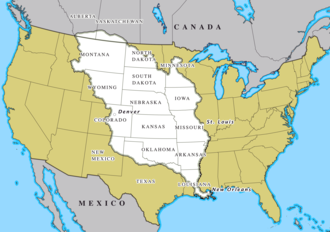
The Louisiana Purchase (French: Vente de la Louisiane, lit. 'Sale of Louisiana') was the acquisition of the territory of Louisiana by the United States from the French First Republic in 1803. This consisted of most of the land in the Mississippi River's drainage basin west of the river.

Treaty of Guadalupe Hidalgo
The Treaty of Guadalupe Hidalgo officially ended the Mexican–American War (1846–1848). It was signed on the 2nd of February 1848 in the town of Guadalupe Hidalgo. After the defeat of its army and the fall of the capital in September 1847, Mexico entered into peace negotiations with the U.S. envoy, Nicholas Trist.