
History of United States expansionism

American frontier
The American frontier, also known as the Old West, and popularly known as the Wild West, encompasses the geography, history, folklore, and culture associated with the forward wave of American expansion in mainland North America that began with European colonial settlements in the early 17th century and ended with the admission of the last few...

Butterfield Overland Mail
Butterfield Overland Mail (officially Overland Mail Company) was a stagecoach service in the United States operating from 1858 to 1861. It carried passengers and U.S. Mail from two eastern termini, Memphis, Tennessee, and St. Louis, Missouri, to San Francisco, California.

California Trail
The California Trail was an emigrant trail of about 1,600 mi (2,600 km) across the western half of the North American continent from Missouri River towns to what is now the state of California.

First transcontinental railroad
America's first transcontinental railroad (known originally as the "Pacific Railroad" and later as the "Overland Route") was a 1,911-mile (3,075 km) continuous railroad line built between 1863 and 1869 that connected the existing eastern U.S.
Frontier Thesis
The Frontier Thesis, also known as Turner's Thesis or American frontierism, is the argument by historian Frederick Jackson Turner in 1893 that the settlement and colonization of the rugged American frontier was decisive in forming the culture of American democracy and distinguishing it from European nations.

Gadsden Purchase
The Gadsden Purchase (Spanish: Venta de La Mesilla "La Mesilla sale"), also known as the Treaty of Mesilla, is a 29,640-square-mile (76,800 km2) region of present-day southern Arizona and southwestern New Mexico that the United States acquired from Mexico.
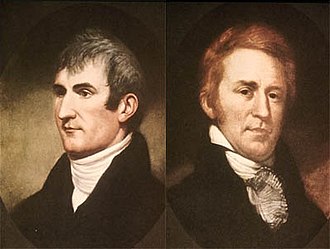
Lewis and Clark Expedition
The Lewis and Clark Expedition, also known as the Corps of Discovery Expedition, was the United States expedition to cross the newly acquired western portion of the country after the Louisiana Purchase. The Corps of Discovery was a select group of U.S.
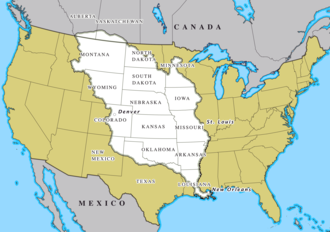
Louisiana Purchase
The Louisiana Purchase (French: Vente de la Louisiane, lit. 'Sale of Louisiana') was the acquisition of the territory of Louisiana by the United States from the French First Republic in 1803. This consisted of most of the land in the Mississippi River's drainage basin west of the river.

Manifest destiny
Manifest destiny was the expansionist belief in the 19th-century United States that American settlers were destined to expand westward across North America, and that this belief was both obvious ("manifest") and certain ("destiny").

Pike Expedition
The Pike Expedition (July 15, 1806 – July 1, 1807) was a military party sent out by President Thomas Jefferson and authorized by the United States government to explore the south and west of the recent Louisiana Purchase. It was led by United States Army Lieutenant Zebulon Pike, Jr. who was promoted to captain during the trip.

Territorial evolution of the United States
The United States of America was formed after thirteen British colonies in North America declared independence from the British Empire on July 4, 1776. In the Lee Resolution, passed by the Second Continental Congress two days prior, the colonies resolved that they were free and independent states.

Treaty of Guadalupe Hidalgo
The Treaty of Guadalupe Hidalgo officially ended the Mexican–American War (1846–1848). It was signed on the 2nd of February 1848 in the town of Guadalupe Hidalgo. After the defeat of its army and the fall of the capital in September 1847, Mexico entered into peace negotiations with the U.S. envoy, Nicholas Trist.