
Literature & Culture
Articles

John Ford
John Martin Feeney (February 1, 1894 – August 31, 1973), better known as John Ford, was an American film director and producer. He is regarded as one of the most important and influential filmmakers during the Golden Age of Hollywood, and was one of the first American directors to be recognized as an auteur.

John Wayne
Marion Robert Morrison (May 26, 1907 – June 11, 1979), known professionally as John Wayne, was an American actor. Nicknamed "Duke", he became a popular icon through his starring roles in films which were produced during Hollywood's Golden Age, especially in Western and war movies.
Lone Ranger
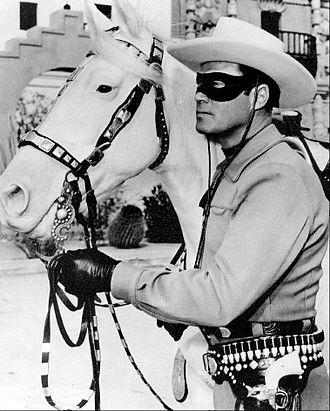
The Lone Ranger is a fictional masked former Texas Ranger who fought outlaws in the American Old West with his Native American friend Tonto. The character has been called an enduring icon of American culture. He first appeared in 1933 in a radio show on WXYZ (Detroit), conceived either by station owner George W.

Louis L'Amour
Louis Dearborn L'Amour (; né LaMoore; March 22, 1908 – June 10, 1988) was an American novelist and short story writer. His books consisted primarily of Western novels, though he called his work "frontier stories". His most widely known Western fiction works include Last of the Breed, Hondo, Shalako, and the Sackett series.

Owen Wister
Owen Wister (July 14, 1860 – July 21, 1938) was an American writer. His novel The Virginian, published in 1902, helped create the cowboy as a folk hero in the United States and built Wister's reputation as the "father of Western fiction.

Pecos Bill
Pecos Bill ( PAY-kəs) is a fictional cowboy and folk hero in stories set during American westward expansion into the Southwest of Texas, New Mexico, Southern California, and Arizona. These narratives were invented as short stories by Tex O'Reilly in the early 20th century and are an example of American "fakelore".

Roy Rogers
Roy Rogers (born Leonard Franklin Slye; November 5, 1911 – July 6, 1998), nicknamed the King of the Cowboys, was an American actor, singer, television host, and rodeo performer.

Spaghetti Western
The spaghetti Western is a broad subgenre of Western films produced in Europe. It emerged in the mid-1960s in the wake of Sergio Leone's filmmaking style and international box-office success. The term was used by foreign critics because most of these Westerns were produced and directed by Italians.
Stagecoach (1939 film)
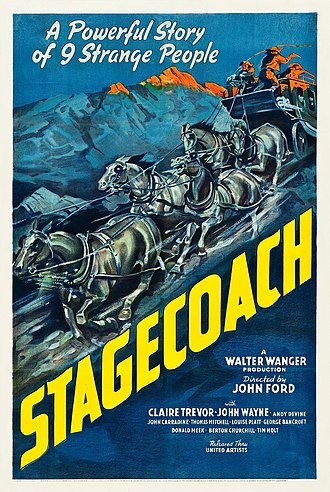
Stagecoach is a 1939 American Western film directed by John Ford and starring Claire Trevor and John Wayne. The screenplay by Dudley Nichols is an adaptation of "The Stage to Lordsburg", a 1937 short story by Ernest Haycox. The film follows an eclectic group of travelers riding on a stagecoach through dangerous Apache territory.

The Great Train Robbery (1903 film)
The Great Train Robbery is a 1903 American silent Western action film made by Edwin S. Porter for the Edison Manufacturing Company. It follows a gang of outlaws who hold up and rob a steam train at a station in the American West, flee across mountainous terrain, and are finally defeated by a posse of locals.

The Searchers
The Searchers is a 1956 American epic Western film directed by John Ford and written by Frank S. Nugent, based on the 1954 novel by Alan Le May.

The Virginian (novel)
The Virginian: A Horseman of the Plains is a 1902 Wild West and cowboy novel by American author Owen Wister, set in Wyoming Territory during the 1880s. Detailing the life of a cowboy on a cattle ranch, the novel was a landmark in the evolution of the Western genre, as distinguished from earlier short stories and pulp dime novels.