
Native Americans
Articles

Kiowa
Kiowa ( KY-ə-wə, -wah) or Ǥáuigú (Kiowa pronunciation: [kɔ́jɡʷú]) people are a Native American tribe and an Indigenous people of the Great Plains of the United States. They migrated southward from western Montana into the Rocky Mountains in Colorado in the 17th and 18th centuries and eventually into the Southern Plains by the early 19th century.

Native Americans in the United States
Native Americans (also called Indians, American Indians, First Americans, and Indigenous Americans) are the Indigenous peoples of the United States, particularly of the lower 48 states and Alaska. They may also include any Americans whose origins lie in any of the Indigenous peoples of North or South America.

Navajo
The Navajo are an Indigenous People of the Southwestern United States. The Navajo term for themselves is Diné. Their language is Navajo (Navajo: Diné bizaad), a Southern Athabascan language. The states with the largest Diné populations are Arizona (140,263) and New Mexico (108,305).

Nez Perce
The Nez Perce ( ; autonym in Nez Perce: nimíipuu, meaning 'we, the people') are an Indigenous people of the Plateau who still live on a fraction of the lands on the southeastern Columbia River Plateau in the Pacific Northwest. This region has been occupied for at least 11,500 years.
Pawnee people
The Pawnee, also known by their endonym Chatiks si chatiks (which translates to "Men of Men"), are an Indigenous people of the Great Plains that historically lived in Nebraska and northern Kansas but today are based in Oklahoma. They are the federally recognized Pawnee Nation of Oklahoma, who are headquartered in Pawnee, Oklahoma.
Plains Indians
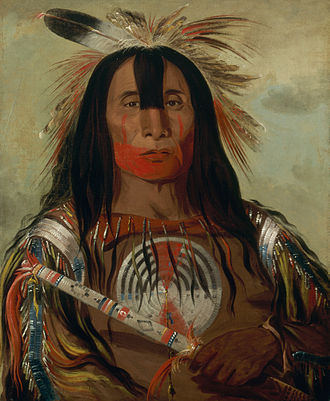
Plains Indians or Indigenous peoples of the Great Plains are the Native American tribes and First Nations peoples who have historically lived on the Interior Plains (the Great Plains) of North America.

Shawnee
The Shawnee ( shaw-NEE) are a Native American people of the Northeastern Woodlands. Their language, Shawnee, is an Algonquian language. The Shawnee precontact homeland was likely centered in southern Ohio. In the 17th century, they dispersed throughout Ohio, Illinois, Maryland, Delaware, and Pennsylvania.
Shoshone
The Shoshone or Shoshoni ( shoh-SHOH-nee or shə-SHOH-nee), also known by the endonym Newe, are an Indigenous people of the United States with four large cultural/linguistic divisions: Eastern Shoshone: Wyoming Northern Shoshone: Southern Idaho Western Shoshone: California, Nevada, and Northern Utah Goshute: western Utah, eastern Nevada They...

Sioux
The Sioux or Oceti Sakowin (, SOO; Dakota/Lakota: Očhéthi Šakówiŋ [oˈtʃʰeːtʰi ʃaˈkoːwĩ]) are groups of Native American tribes and First Nations people from the Great Plains of North America. The Sioux have two major linguistic divisions: the Dakota and Lakota peoples (translation: 'friend, ally' referring to the alliances between the bands).

Trail of Tears
The Trail of Tears was the forced displacement and ethnic cleansing of about 60,000 Native Americans of the "Five Civilized Tribes", including their black slaves, between 1830 and 1850 by the United States government.

Ute people
Ute () are an Indigenous people of the Great Basin and Colorado Plateau in present-day Utah, western Colorado, and northern New Mexico. Historically, their territory also included parts of Wyoming, eastern Nevada, and Arizona. Their Ute dialect is a Colorado River Numic language, part of the Uto-Aztecan language family.

Wounded Knee Massacre
The Wounded Knee Massacre, also known as the Battle of Wounded Knee, was an 1890 armed conflict between Native Americans and the United States Army. It was part of the U.S. Army’s Pine Ridge Campaign. Between 250 and 300 Lakota people were killed, and 51 were wounded (four men and 47 women and children, some of whom died later). Twenty-five U.S.